

The Thames Regional Flood and Coastal Committee (RFCC) has published its strategy for managing flood and coastal erosion risk over the next decade setting out a clear direction for how the Committee will work with partners and communities across the Thames region.
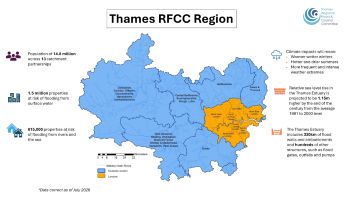
The Thames RFCC region encompasses one of the most complex and diverse catchments in England. It includes more than a quarter of the country’s population and significant national infrastructure.
The region experiences a complex mix of flood risk from:
- rivers (fluvial)
- surface water
- groundwater
- sea
Updated evidence indicates that more than 1.5 million properties are at risk from surface water flooding, and over 615,000 properties are at risk from rivers and the sea.
Climate change, growth and changing land use are impacting the strategic nature of these risks, meaning a holistic strategy is needed that is forward looking, evidence-led and adaptable to these long-term pressures.
Building on the 2021 Strategy, the 2026 Strategy sets refreshed priorities to:
- guide investment
- strengthen partnership working
- improve community resilience
The Strategy aligns with Defra’s 2025 flood funding reforms and the 2026 to 2029 investment programme, providing a strategic framework for coordinated action across the region. The Strategy was developed collaboratively with:
- Thames RFCC
- lead local flood authorities
- Environment Agency
- other risk management authorities
It provides clear direction for:
- reducing flood risk
- strengthening evidence
- supporting communities
- achieving better outcomes through partnership working
All proposals submitted to the Thames RFCC will be expected to demonstrate how they contribute to the delivery of the Strategy.
The Strategy is built around 5 principles:
- Put communities at the heart of everything we do
- Create resilient communities, property, infrastructure and environments
- Connect, inspire, lead and share across communities and partners
- Pioneer, learn and strengthen the evidence base
- Attract, prioritise, allocate and monitor funding
The Environment Agency will review the Strategy as required, including at the start of the next investment programme to ensure it remains aligned with national priorities and emerging challenges. Progress will be monitored through the supporting monitoring framework to allow Thames RFCC and its partners to track delivery and maintain focus on achieving long-term outcomes.
Click here to download the Thames Regional Flood and Coastal Committee Strategy August 2026
 Near-real-time microbial monitoring of wastewater discharge and bathing waters is now possible thanks to the BactoSense ID solution created by Swiss-based bNovate Technologies.
 ABB has launched AquaMaster+™, a digital platform for smart water network management, designed to help water utilities monitor, analyze and manage their water networks, preventing pipeline water losses and optimizing operations.
 Craig Nienaber, Business Development Manager for Safe Access Solutions (SAS) at HUBER Technology, explores why the company is seeing a growing level of interest in its safe access solutions for critical infrastructure providers, including their application in wastewater treatment assets.
 Albion Water, the first NAV (New Appointment & Variation) to have been established in1999 and now under the ownership of SDS Water Group, has appointed Andy Holland as its new Director of Business Development.

 Southern Water has released film and images showing what it’s like to walk inside Hampshire’s expanded Yew Hill underground reservoir for the very last time, before it gets filled with water.
 Hear how Scottish Water has completed its £235 million Ayrshire Glasgow Resilience Project - customers across Greater Glasgow, Ayrshire and East Renfrewshire will now benefit from a more secure and resilient water supply.
 Hear how United Utilities is accelerating its investment to reduce spills from storm overflows across the Northwest.