

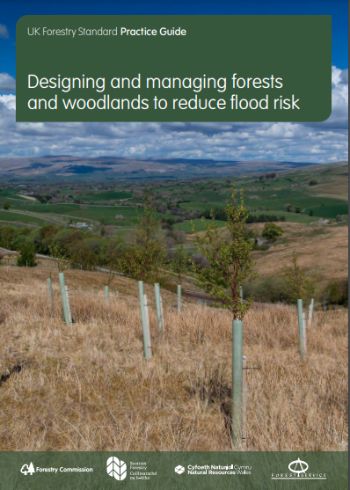
A new United Kingdom-wide guide outlining how forests and woodlands can reduce the damaging effects and financial impact of flooding has been published today by the Forestry Commission, Natural Resources Wales, Scottish Forestry and Northern Ireland Forest Service.
Flooding is a major environmental and economic hazard facing the United Kingdom, with major floods already costing multiple £ billions, which is set to increase as a result of climate change.
The Guide will enable the forest sector to play a stronger role in flood mitigation, which will increase the resilience of communities to flooding and reduce the financial impact of future floods.
Advice in the new UK Forestry Standard Practice Guide includes how woodland creation can be used to reduce flood risk and how management operations can be modified to minimise their impact on flood flows.
Woodlands can play a key role in flood mitigation and make an important contribution to reducing downstream flood risk. Tree planting can significantly affect the volume, pathway and timing of surface run-off, slowing and reducing flood peaks, while management operations such as cultivation, drainage, road construction and harvesting can have the opposite effect if not appropriately managed.
Produced by Forest Research, the new Practice Guide provides advice to landowners, forest and woodland managers, planners, practitioners and flooding authorities on how forests and woodlands can make a positive contribution to natural flood management and play a stronger role in flood mitigation.
Advice set out in the Guide includes:
- How to identify whether downstream communities are vulnerable to flooding and if so, modify the design of the woodland to enhance the flood benefit
- How to amend the scale, timing and type of woodland operations to minimise the impact of flood risk and flood run-off
- Where and how to use leaky dams to slow flood flows
Applying the guidance will assist land managers and forestry practitioners in meeting the requirements of the UK Forestry Standard (UKFS) and will help deliver a more sustainable and integrated approach to managing flood risk – reducing the damaging effects and financial impacts of future floods on downstream communities.
Richard Stanford, Forestry Commission Chief Executive, said:
“Our woodlands and forests play a key role in reducing the peaks in water flow. This helps to protect communities across the UK vulnerable to flooding from their devastating impacts.
“This new Practice Guide will enable the forestry sector to harness the benefits of tree growing to reduce the risk of flooding, while ensuring that management operations do not increase peak flows. It will promote working with natural processes to deliver a more sustainable, catchment-based approach to managing flood risk to benefit communities across the UK.”
Dominic Driver, Natural Resources Wales’ Head of Land Stewardship, said:
“Helping to prevent flooding is one of the many benefits of planting trees and creating new woodlands, but we also recognise that inappropriate forest management can risk environmental harm and reduce the well-being benefits that we derive from water.
“The UK Forestry Standard helps us ensure sustainable forest management in Wales, and this practice guide will help contribute to that. We will now be integrating this practice guide to our work in managing and regulating forestry activities.”
A wide range of organisations are responsible for managing flood risk across the United Kingdom and rely on partnership working to help protect affected communities and assets from flooding.
Implementing the guidance as described will enable foresters to meet UKFS requirements and guidelines, and in so doing, make a positive contribution to reducing flood flows and the damaging effects of flooding.
By playing a stronger role in flood mitigation, it will also help the forest sector increase the resilience of downstream communities likely to be impacted by more frequent flooding due to climate change.
Click here to download the Guide
Climate change and growing flood risk – the upcoming Floodex 2022 event which takes place in London on 23rd and 24th November will highlight the need for multi-sector partnerships and collaboration to tackle growing flood risk in the face of the accelerating impacts of climate change. Click here to register for free entry
 Albion Water, the first NAV (New Appointment & Variation) to have been established in1999 and now under the ownership of SDS Water Group, has appointed Andy Holland as its new Director of Business Development.
 UK water companies are invited to join an upcoming webinar which will explore how the sector can take indirect potable reuse (IPR) from concept to full-scale operational reality.
 James Sumsion, CEO of predictive water intelligence specialists Kohtari, says the water sector needs to take a giant leap forward, so that it can anticipate and act upon water quality issues - rather than merely react.
 Ray Moulds, Sales Director at Flood Control International, takes a look at how automated sliding floodgates are supporting secondary containment at water and sewerage company sites.

 Hear how Scottish Water has completed its £235 million Ayrshire Glasgow Resilience Project - customers across Greater Glasgow, Ayrshire and East Renfrewshire will now benefit from a more secure and resilient water supply.
 Hear how United Utilities is accelerating its investment to reduce spills from storm overflows across the Northwest.
 Find out more about the remarkable career opportunities on offer at WSP - scroll down to watch the inspirational video.