

Yorkshire Water is working to embed sustainable accounting across its business by quantifying the natural, social and human impacts of projects and decisions alongside financial assessments.
The utility has published a new report unveiling an innovative approach it has adopted to better understand the impact the firm has on people, the environment and the economy.
The report, ‘Our Contribution to Yorkshire’, explains how sustainability has been embedded into the firm’s business model to assess its contribution to wider society.
Known as ‘The Capitals’ concept, the innovative business philosophy involves looking at all projects from six key perspectives - financial, manufacturing, natural, social, human and intellectual capital.
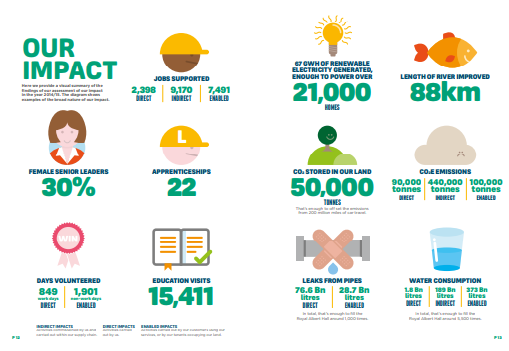 Yorkshire Water said the approach is being embraced by the firm and its supply chain as it looks to drive environmental and social outcomes, as well as purely economic and financial gains. Gordon Rogers, Head of Sustainability at Yorkshire Water, said:
“We are one of few companies in not just the UK but the world that has trailblazed ‘The Capitals’ model in a bid to assess our impact on society and the environment, as well as the economy. Overall, by applying best practise accounting we have calculated we make a very strong ‘net-positive’ contribution to the society we serve. This concept is now helping to shape decision-making across a variety of company projects, such as our new land management strategy.”
“The more we have looked, the more potential we have seen to apply the capitals approach to broaden and advance out thinking about impact and value. We’ve created new tools to help us do this more quickly and more extensively in the future, helping optimise our plans and investment choices based on a rich view of associated costs and benefits.”
Yorkshire Water is embedding the concept of the six Capitals into its long-term business planning.
Describing the Capitals as “the valuable assets which are critical to the success of any organisation”, the utility said effective management of the Capitals would help ensure the resilience of its business.
Yorkshire Water has followed three categories of impact - Direct, Indirect and Enabled:
- Direct – impacts occurring as a result of activities it carries out.
- Indirect – impacts occurring as a result of activities it commissions and carried out within the supply chain.
- Enabled – impacts occurring as a result of activities carried out by customers using its services, or by tenants on its land.
Data on direct impacts stemming from activities wholly controlled by the company where it has more influence is more easily sourced and generally provides a higher confidence than data for indirect and enabled activities, Yorkshire Water said.
Yorkshire’s first Total Impact and Value Assessment ( TIVA) focused on its impact in 2014/15 - chosen because financial year 2014/15 was the most recent complete year for which data were available. For the most part, the TIVA has assessed flows rather than stocks i.e.changes in the capitals’ values rather than their total value. Wherever possible, the impacts have been expressed in quantified monetary values to illustrate their scale, and to facilitate direct comparison between activities.
Yorkshire Water is aiming to eventually carry out full stock valuations for each capital, with annual opening and closing balances.
Both large and small-scale decisions at the water company are already being made on the basis of evidence that includes predicted positive and negative effects on nature and society.
The water company is working with organisations including the Cambridge Institute for Sustainability Leadership, Accounting for Sustainability (A4S) and the Natural Capital Coalition to inform internationally developing techniques to better quantify natural and social impacts and improve its risk management and decision making.
Click here to download Our Contribution to Yorkshire
Click here to download Yorkshire Water’s first Total Impact and Value Assessment ( TIVA)
 Albion Water, the first NAV (New Appointment & Variation) to have been established in1999 and now under the ownership of SDS Water Group, has appointed Andy Holland as its new Director of Business Development.
 UK water companies are invited to join an upcoming webinar which will explore how the sector can take indirect potable reuse (IPR) from concept to full-scale operational reality.
 James Sumsion, CEO of predictive water intelligence specialists Kohtari, says the water sector needs to take a giant leap forward, so that it can anticipate and act upon water quality issues - rather than merely react.
 Ray Moulds, Sales Director at Flood Control International, takes a look at how automated sliding floodgates are supporting secondary containment at water and sewerage company sites.

 Hear how Scottish Water has completed its £235 million Ayrshire Glasgow Resilience Project - customers across Greater Glasgow, Ayrshire and East Renfrewshire will now benefit from a more secure and resilient water supply.
 Hear how United Utilities is accelerating its investment to reduce spills from storm overflows across the Northwest.
 Find out more about the remarkable career opportunities on offer at WSP - scroll down to watch the inspirational video.