

A a new report by the World Bank and the Global Facility for Disaster Reduction and Recovery (GFDRR) is warning that without significant investment to improve the resilience of cities around the world, climate change may push up to 77 million more urban residents into poverty by 2030.
Introducing the report, the World Bank said that the world has a brief window of opportunity to make cities more resilient, but it will take a significant amount of funding—especially for developing countries.
The report, released ahead of the United Nations Conference on Housing and Sustainable Urban Development (or Habitat III), discusses the challenges and opportunities of unlocking investment in resilient infrastructure for improved urban livelihoods worldwide.
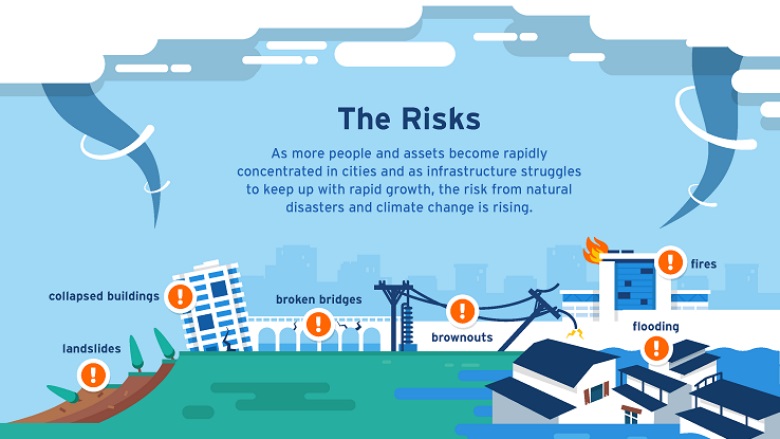 Investing in Urban Resilience argues that climate change and increasing urbanization may have devastating effects, and that they will strike hardest at the biggest drivers of global development:
Failure to build resilience will cost cities worldwide $314 billion each year by 2030
The report is warning that if cities fail to build their resilience to disasters, shocks, and ongoing stresses, climate change and natural disasters will cost cities worldwide $314 billion every year by 2030, and 77 million more people—or more than the entire population of the Democratic Republic of the Congo—will soon be living and laboring in the shadow of poverty.
The low resilience of growing cities is particularly dangerous to the urban poor. Globally, 881 million urban residents are living in slums, up by 28% since 2000. The informal and unplanned settlements are often built in high-risk locations, such as slopes or floodplains, and lack basic risk-reducing infrastructure.
However, the report says there is also reason for optimism. Almost 60% of the areas that will be urbanized by 2030 haven’t been developed yet, which means that the world has a brief window of opportunity for investment—but it will take a significant amount of funding.
Estimated $4.5 trillion urban infrastructure investment per year is needed worldwide
Research has estimated that, worldwide, the need for urban infrastructure investment is $4.5 trillion per year, and that making this infrastructure low carbon and climate resilient will take a premium of 9% to 27%. Much of this demand comes from cities in the developing world.
According to the Bank, the funding to do it is out there: between public, private, and philanthropic sources of funding, there is $106 trillion of private institutional capital available worldwide. However, currently only 1.6% of it is invested in infrastructure at all, let alone in making that infrastructure resilient.
Why such a large funding gap?
“Investors are struggling with a range of obstacles when it comes to investing in resilience,” said Francis Ghesquiere, Head of GFDRR. “More often than not, the capacity of municipalities to integrate risk reduction components in their programs, and to access funding, is limited. We need to find innovative ways to overcome these challenges if we are to avoid the disaster of tomorrow.”
TRhe report says developing cities face a number of major barriers when trying to fund resilience investments, including:
- Lack of government capacity. Cities may struggle with political uncertainty, regulatory systems that deter private investment, and difficulties planning, financing, and implementing projects.
- Lack of private sector confidence. Private-sector investors are frequently concerned about limited institutional capacity, weak governance, currency risk, and limited benchmarking data that can be used to measure an investment’s performance.
- Challenges in project preparation. The technical capacity and upfront costs needed to prepare projects mean that cities are able to offer few ready-to-go urban resilience projects to investors for financing.
To help cities overcome these barriers and boost investment in urban resilience, the World Bank has invested an average of $2 billion a year in building resilient cities over the past five years, working on 79 projects in 41 countries.
The Bank also aims to make a global impact on the worldwide urban resilience agenda through its far-reaching partnerships, including the 100 Resilient Cities network and the Medellín Collaboration on Urban Resilience.
The report says that while multilateral partnerships are crucial for leveraging private funding, more than money is needed in order to increase urban resilience - including a focus on improving the policy environment in cities so that investors are willing and eager to fund resilience projects, and boosting the capacity of local governments to implement them.
Click here to download the Investing in Urban Resilience report
 ABB has launched AquaMaster+™, a digital platform for smart water network management, designed to help water utilities monitor, analyze and manage their water networks, preventing pipeline water losses and optimizing operations.
 Craig Nienaber, Business Development Manager for Safe Access Solutions (SAS) at HUBER Technology, explores why the company is seeing a growing level of interest in its safe access solutions for critical infrastructure providers, including their application in wastewater treatment assets.
 Albion Water, the first NAV (New Appointment & Variation) to have been established in1999 and now under the ownership of SDS Water Group, has appointed Andy Holland as its new Director of Business Development.
 UK water companies are invited to join an upcoming webinar which will explore how the sector can take indirect potable reuse (IPR) from concept to full-scale operational reality.

 Southern Water has released film and images showing what it’s like to walk inside Hampshire’s expanded Yew Hill underground reservoir for the very last time, before it gets filled with water.
 Hear how Scottish Water has completed its £235 million Ayrshire Glasgow Resilience Project - customers across Greater Glasgow, Ayrshire and East Renfrewshire will now benefit from a more secure and resilient water supply.
 Hear how United Utilities is accelerating its investment to reduce spills from storm overflows across the Northwest.