

Scottish Water is supporting trials by Sainsbury’s supermarket to encourage customers to recycle their waste cooking oil, whilst also saving their kitchen sink from blockages often caused when oils are poured down the drain.
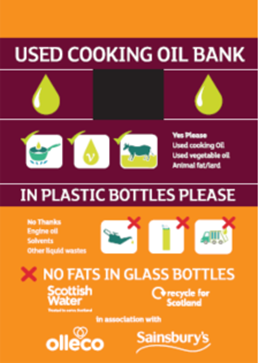 The 20th May saw Sainsbury’s Leven, Kirkcaldy, Linlithgow and stores across Edinburgh launch a trial of recycling banks for cooking oils. The supermarket is working in partnership with Scottish Water, Zero Waste Scotland and Olleco, which provides foodservice businesses with resource recovery solutions.
Customers can simply deposit household cooking oil waste including vegetable oil, animal fat and lard in a plastic bottle at the recycling banks located in Sainsbury’s car parks. From there the oils are collected by Olleco and taken to its recycling plant to be converted into biodiesel.
Paul Crewe, Head of Sustainability at Sainsbury’s commented:
“Cooking oils probably aren’t the first thing you’d think of recycling however it’s a great way of keeping your drains clear and putting waste to a good use. This is an exciting trial that adds to the recycling our customers already get involved in, including clothing, and even Christmas cards.”
The trial was welcomed by Scottish Water, as this links to their Cycle campaign which aims to highlight simple steps to prevent blocked pipes.
Scott Fraser, Scottish Water Campaign Manager, said:
“Scottish Water deals with around 37,000 blockages a year – 80% of which are caused by kitchen and bathroom waste being disposed of incorrectly down toilets or sinks.
“We are pleased to support this trial which offers customers the chance to recycle their used fat, oil and grease, and play their part in helping to keep the water cycle running smoothly – while protecting the environment.”
Adam Baisley, Biodiesel and Business Development Director at Olleco commented:
"This trial is a fantastic opportunity for households to make more of their kitchen waste. Blocked drains are a problem and pouring oils away is a waste of something that can be recycled. Once it is converted into biodiesel it becomes a fuel with over 95% greenhouse gas savings versus fossil fuels – isn’t that a better solution than having to pay the millions needed to clear our country’s drains yearly?”
 Enpure Ltd and Clean TeQ Water Ltd have announced a collaboration agreement to bring Clean TeQ Water's Moving Bed Ion Exchange-based nutrient removal technologies to water utilities across the UK.
 Near-real-time microbial monitoring of wastewater discharge and bathing waters is now possible thanks to the BactoSense ID solution created by Swiss-based bNovate Technologies.
 ABB has launched AquaMaster+™, a digital platform for smart water network management, designed to help water utilities monitor, analyze and manage their water networks, preventing pipeline water losses and optimizing operations.
 Craig Nienaber, Business Development Manager for Safe Access Solutions (SAS) at HUBER Technology, explores why the company is seeing a growing level of interest in its safe access solutions for critical infrastructure providers, including their application in wastewater treatment assets.

 Southern Water has released film and images showing what it’s like to walk inside Hampshire’s expanded Yew Hill underground reservoir for the very last time, before it gets filled with water.
 Hear how Scottish Water has completed its £235 million Ayrshire Glasgow Resilience Project - customers across Greater Glasgow, Ayrshire and East Renfrewshire will now benefit from a more secure and resilient water supply.
 Hear how United Utilities is accelerating its investment to reduce spills from storm overflows across the Northwest.