
The latest European Innovation Union Scoreboard suggests that the United Kingdom is lagging behind its competitor countries on innovation performance - the lowest innovation growth rates were recorded in Sweden, the UK and Croatia.
The annual Innovation Union Scoreboard (IUS) provides a comparative assessment of the research and innovation performance of the EU Member States and the relative strengths and weaknesses of their research and innovation systems.
EU Member States’ innovation performance
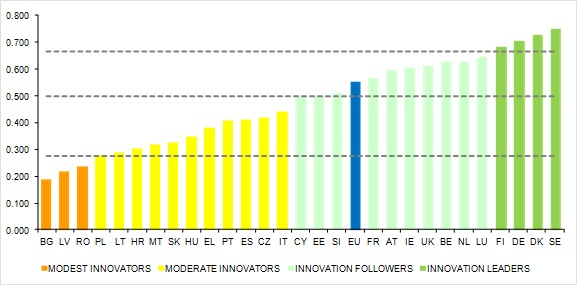
The IUS is intended to help Member States assess areas in which they need to concentrate their efforts in order to boost their innovation performance.
The latest Scoreboard ranks the United Kingdom is an Innovation follower. After a decline in 2008 performance improved strongly in 2009 and in 2010, in particular due to increases in Innovative SMEs collaborating with others. Since 2010 performance has been stable with a small decline in 2013. The performance relative to the EU has declined from almost 120% in 2006 to 111% in 2013.
Relative strengths for the United Kingdom are in international scientific co-publications, innovative SMEs collaborating with others and new doctorate graduates. Relative weaknesses are in sales share of new innovations and SMEs with product and/or process innovations.
Performance in terms of growth has improved most for Innovative SMEs collaborating with others and International scientific co-publications. Strong declines in growth are observed in sales share of new innovations and SMEs with product and/or process innovations.
The IUS groups a total of 25 different indicators under the following three main categories of indicators:
- Enablers: the basic building blocks which allow innovation to take place - human resources, open, excellent and attractive research systems, and finance and support.
- Firm activities: which capture innovation efforts in European firms - firm investments, linkages and entrepreneurship, and intellectual assets.
- Outputs: show how this translates into benefits for the economy as a whole - innovators and economic effects.
The Scoreboard also covers Serbia, Former Yugoslav Republic of Macedonia, Turkey, Iceland, Norway and Switzerland. On a more limited number of indicators, available internationally, it also covers Australia, Brazil, Canada, China, India, Japan, Russia, South Africa, South Korea and the US.
The IUS' main conclusdions are that Europe is closing its innovation gap with the United States and Japan but differences in performance between EU Member States are still high and diminishing only slowly. At a regional level, the innovation gap is widening, with the innovation performance having worsened in almost one fifth of EU regions.
Every two years the Innovation Union Scoreboard is accompanied by a Regional Innovation Scoreboard. The Regional Innovation Scoreboard 2014 provides a comparative assessment of innovation performance across 190 regions of the European Union, Norway and Switzerland using a limited number of research and innovation indicators.
The IUS concludes that overall, the EU annual average growth rate of innovation performance reached 1.7% over the analysed eight-year period 2006-2013 with all Member States improving their innovation performance. Portugal, Estonia and Latvia are identified as innovation growth leaders, i.e. the countries with the highest rate of innovation performance improvement. The lowest innovation growth rates were recorded in Sweden, the UK and Croatia.
In two dimensions the overall change of performance was negative: Firm investments and Finance and support. In particular, the positive growth of public R&D expenditures (1.8%) was offset by a continuous decline in venture capital investments (-2.8%). In addition, a positive improvement in Business R&D expenditure (2.0%) was negatively offset by firms’ Non-R&D innovation expenditures (-4.7%), (Figure 3).
South Korea, the US and Japan have an innovation performance lead over the EU
Taking into account European countries outside the EU, this year Switzerland confirms its position as the overall Innovation leader by continuously outperforming all EU Member States. Iceland is one of the Innovation followers with an above EU-average performance, Norway and Serbia are Moderate innovators and the Former Yugoslav Republic of Macedonia and Turkey are Modest innovators.
When looking at performance of innovation systems in a global context, South Korea, the US and Japan have an innovation performance lead over the EU. The United States and South Korea outperform the EU both by 17% and Japan by 13%. While the gap between the US and Japan is decreasing, it widens with South Korea.
The top innovation leaders US, Japan and South Korea are particularly dominating the EU in indicators capturing business activity as measured by R&D expenditures in the business sector,
However, compared with other key international partners, the EU continues to have a performance lead over Australia and Canada that score at 62% and 79% of the EU level respectively. The performance lead is even larger compared to the BRICS countries (Brazil, Russia, India, China and South Africa). This lead is stable or even increasing for almost all BRICS countries, except for China. China’s current innovation performance is at 44% of the EU level, and continues to reduce the gap by improving faster and at a higher rate than the EU.
Apart from the innovation performance of the individual EU Member States as well as their strengths and weaknesses, the IUS’s key conclusion is that the most innovative countries perform best on all dimensions: from research and innovation inputs, through business innovation activities up to innovation outputs and economic effects.
Reflecting balanced national research and innovation systems, the performance of the Innovation leaders, Sweden, Denmark, Germany and Finland, is not too different in all dimensions. The Innovation leaders are also mostly on top and clearly above the EU average.
Click here for the Innovation Union Scoreboard 2014
Click here for the Regional Innovation Union Scoreboard 2014