
The cross-party House of Lords Industry and Regulators Committee is warning that failures by Government to give clear guidance to regulators on economic growth could drive new investment away from the UK.
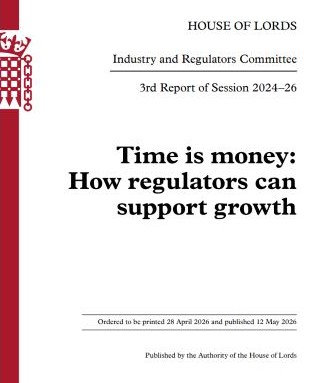
In ‘Time is money: How regulators can support growth’, a new report published today, the Committee is calling on the Government to give clear guidance to regulators on trade-offs between supporting economic growth and their other responsibilities, such as consumer and environmental protections. The Committee says regulators need to provide speed and certainty in their decision making to help businesses make investments.
According to the report, the Committee heard extensive evidence on the difficulty of identifying the role of regulators in supporting growth.
"We heard that the perception and operation of UK regulation can affect international investment. Simon Wilde from Oxera explained that the UK is “in a global competition for capital. Investors have choices.” the report says.
Most witnesses stressed the need for regulators to provide long-term stability and predictability to encourage investment and to enable companies to plan ahead. However, many said that that certainty and consistency must be balanced with a degree of flexibility to facilitate innovation. The report cites Mark Thurston, Chief Executive Officer of Anglian Water, who described long-term stability around a regulatory environment as “crucial for investment” but also alluded to “sufficient flex in the system” so that companies can deal with “emerging demands.”
Witnesses also suggested increasing the use of mutual recognition where products or services had already received equivalent regulatory approval in another country. Lord Willetts, explained:
“If Canada has approved your medical device and we know the Canadian system, do we really need to go back to the beginning and start all over again? Can we not just say, ‘Well, if you have passed muster in Canada you will probably be okay here’? We can do a bit more to get the benefits when we have a trusting relationship with another country.”
The Committee is recommending that the Government should guide and direct decisions about alignment or mutual recognition with other jurisdictions, subject to the UK’s international responsibilities.
The Committee is also calling on the Government to:
- provide political cover where it wants a regulator to be more open to risk;
- legislate to ensure the regulatory framework can adapt to new technologies, products and services, if necessary through a Regulatory Reform Bill;
- estimate the extent to which the Government’s Action Plan will reduce the actual cost of compliance with regulation, rather than just the administrative costs of regulation;
- work with regulators to identify where lead regulator models could be implemented more broadly and speedily, including across departmental boundaries;
- ensure sponsoring departments have suitable metrics to hold regulators to account for their pace and the outcomes of their work.
Chair of the Committee, Baroness Hayter said:
“The Government says economic growth is its number one aim and wants regulators to help facilitate this. Our inquiry found that, for this to happen, Government itself must take difficult decisions on how regulators should balance economic growth with the protections that citizens and the environment rely on, and the levels of risk to which the public should be exposed.
“Regulators must play their part by performing their functions more effectively, providing the speed and certainty businesses need to make investments, and the flexibility to respond to innovation.
“If growth is the government’s priority, it must provide clarity to regulators about its expectation and the political coverage for them to be less risk averse. The time to act is now.”
The Committee is calling on regulators to:
- speed up their internal processes to reduce delays that make the UK a less attractive prospect for investment;
- proactively engage with industry to ensure companies know what is required of them;
- make use of tools such as regulatory sandboxes to test innovative products, services and technologies.

The report also refers to pilot projects Defra is conducting of a lead regulator providing coordination and a single point of engagement for major projects. The report says Defra felt that "the model showed potential, but pointed out limitations in that it cannot currently carry the model outside the regulators within its remit, such as planning authorities, and that legislation would be required to move to a model where lead regulators could take on decisions usually made by other regulators."
The Committee has welcomed the Government’s pilot of a proposal for lead environmental regulators, creating a single point of contact for large projects that encounter multiple environmental regulators.
However, it cautions:
"We are concerned this only applies to regulators within one department. It also only allows the lead regulator to coordinate communications on projects, rather than holding decision-making power."
The Government is expected to publish its formal response to the report by 12 July 2026
Click here to download the report in full