
Ofwat has launched a new consultation on its approach to enforcement – including how whistle blowers working in water companies seeking to flag up potential breaches of obligations should provide information and encouraging them to first use the whistle blowing procedures in their workplace.
Introducing the consultation, the regulator said the enforcement guidance should be read alongside its ‘Statement of policy with respect to financial penalties’. At this stage, Ofwat is not proposing making changes to the statement of policy, but said it will keep this and its approach to enforcement under review.
Ofwat’s ‘Forward programme 2015-16’, committed the regulator to providing information on how customers can benefit from using ‘settlement’ in resolving individual cases, a risk-based approach to regulation and how it intends to balance these benefits with its statutory duties to use its formal enforcement powers. As part of this Ofwat said it has reviewed and refreshed its existing approach to enforcement, which was first set out in guidance published in July 2009, to reflect changes in the water sector in England and Wales generally, and in particular its approach to regulation.
The UK Government paper ‘A better deal: boosting competition to bring down bills for families and firms’ published in November 2015 said enforcement action should be a last resort and that “regulators should start by helping businesses do the right thing.”
To reflect a number of changes to both the water sector and the regulatory landscape that have taken place since 2009, Ofwat has refreshed the following elements in the existing enforcement document:
- out-of-date references to the previous strategy
- changes to the regulatory landscape – in particular, amendments to the Water Industry Act 1991 made by the Enterprise and Regulatory Reform Act 2013 and by the Water Act 2014.
- out-of-date contact details.
- informing stakeholders of Ofwat’s approach to settlement.
The consultation paper sets out the type of arrangements known as ‘settlement’. These cover cases where although Ofwat finds that a company has breached its licence or a statutory obligation, it may consider not opening a formal enforcement case if the company satisfies the regulator that a breach is not ongoing and the company has taken steps to provide appropriate redress to the customers. It may also start formal proceedings against a company but agree to a reduced penalty if that company puts in place measures to provide customers with appropriate redress.
Ofwat said that while its approach to settlement has been informed by the process used in other regulated sectors, it reflects the unique legal framework in the water sector.
Ofwat: we will usually pursue informal regulatory action with companies first
The regulator is proposing to take what it describes as a stepped approach where it has concerns that a company is contravening its obligations, or may do so in the future, saying:
“ We will usually pursue informal regulatory action with companies first where that is the most appropriate means of making sure that they meet their obligations. If this does not achieve the desired result, we may take formal regulatory action, including enforcement.”
Image: Ofwat enforcement tools - source Ofwat
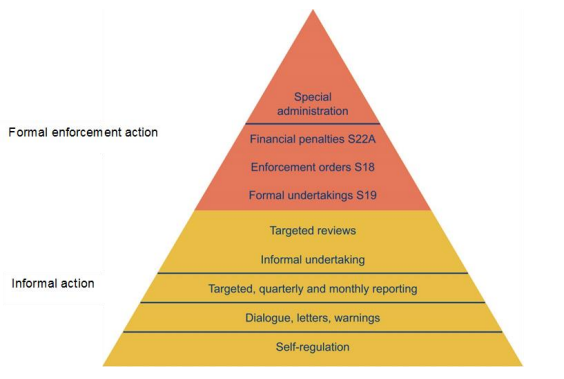 To deliver the most beneficial outcomes to customers Ofwat intends to focus on cases that:
- reduce a significant occurrence of customer harm or detriment;
- set a precedent that encourages beneficial changes in the sector; or
- set a precedent that prevents similar cases in the future by, for example, encouraging water companies to change how they treat customers.
In considering whether to pursue formal enforcement action, Ofwat said it will consider the effects of the action both on the company in question, and on the water sector as a whole. The paper states:
“Using these enforcement tools and being transparent about their use may also incentivise other companies to change their behaviour. Imposing either a financial penalty or an enforcement order indicates to the company in question, and others in the sector, that certain behaviours are not acceptable and are sufficiently serious to attract a formal sanction. This will incentivise changes in behaviour and deter other companies from acting in a similar way.”
Enforcement approach relevant with the emergence of competition
However, Ofwat cautioned that some contraventions are so serious that they are likely to always require a financial penalty, citing the example of cases where companies have deliberately misreported information, causing harm both to customers and other market participants. Where this has occurred the regulator said it had imposed a substantial financial penalty.
Ofwat will also consider whether the company has wrongfully benefited from the incident – which may include financial or reputational benefits where companies may have benefited financially through price limits or through incentive mechanisms. The regulator has drawn attention to the fact that by reporting a more favourable position than was the case, a company may have benefited from an enhanced reputation. Ofwat said that with the emergence of competition, an enhanced reputation may attract more customers and increase revenue.
The paper says that where breaches are identified, Ofwat will make an assessment of the position the company would have been in had the failure or contravention not occurred, and of the benefit it has gained . Ways in which possible breaches or failures by companies to meet their obligations could come to the attention of the regulator include:
- a company self-reporting – if a company finds a possible contravention or fails to meet statutory standards, Ofwat expects it to advise immediately it becomes aware of any potential problem;
- publically available information, including the information companies provide to their customers;
- information from other stakeholders (including other regulators);
- customer complaints and enquiries;
- market research; or
- information received from investors.
Whistleblower provisions - use workplace procedures in the first place
Ofwat has also flagged up the possibility of information on potential breaches coming from whistleblowers employed by a water company, or individuals who have worked for - and presumably also with - a water company.
The paper states:
“When we have received allegations from a complainant, we will endeavour to keep the complainant informed, in general terms, of any key progress, whether the complainant is a whistle blower or a third party complainant who has an interest in how we address their complaint. We will also always advise the complainant whether we have accepted the matter for investigation.”
In its final section which specifically addresses whistle blower contact, Ofwat says:
“If you are a water company employee or have worked for a company and consider that a company may be breaching its obligations, we would encourage you first to use the whistle blowing procedures in your workplace. If your workplace does not have a whistle blowing procedure, or if you do not feel able to do so (for whatever reason), contact our case management office by email at This e-mail address is being protected from spambots. You need JavaScript enabled to view it , by phone ….or in writing.”
However, whether whistle blowers will be guaranteed confidentiality or whether they will still fall under Ofwat’s general approach to obligations of confidence has not been made clear.
Ofwat’s general approach with regard to this issue, which is covered in the introductory section on how to respond to the consultation, states:
“If you would like the information that you provide to be treated as confidential, please be aware that, under the FoIA (Freedom of Information Act), there is a statutory ‘Code of Practice’ with which public authorities must comply and which deals, among other things, with obligations of confidence. In view of this, it would be helpful if you could explain to us why you regard the information you have provided as confidential. If we receive a request for disclosure of the information we will take full account of your explanation, but we cannot give an assurance that we can maintain confidentiality in all circumstances.”
Ofwat said its approach to enforcement takes a step towards delivering the UK Government’s broader objective of reducing regulation in order to encourage competition. Key questions the regulator is seeking comment on are:
1. Do you think the proposed changes to our approach to enforcement are proportional and targeted?
2. Which areas, if any, would you like Ofwat to focus on in any future review of our approach to enforcement?
Deadline for responses to the consultation is 6th May - click here to download the consultation paper.