
The National infrastructure Commission is warning that climate change will continue to increase the risk of flooding and pressure on flood risk management and drainage infrastructure - highlighted by recent surface water flooding events over the summer.

The Commission draws attention to the fact that government has committed to planning for at least a two degree increase in global temperatures and being adaptive to accommodate a potential four degree increase.
The NIC warning comes in one of a number of appendices which accompany the NIC’s new report The Second National Infrastructure Assessment: Baseline Report published in November.
The baseline report, which pinpoints strategic gaps in infrastructure planning, kicks off the process for the next landmark national assessment by the NIC of the UK’s long term infrastructure priorities, to be published in 2023, following analysis of the current performance of key sectors.
Flood resilience - more flood management and drainage assets likely to be required
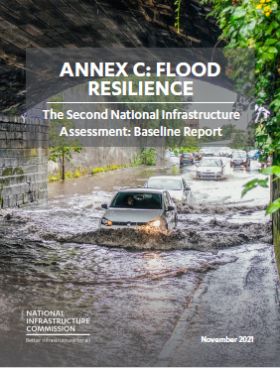
According to the Appendix C report on flood resilience, more flood management and drainage assets are likely to be required and existing assets may deteriorate at a faster pace than anticipated making maintenance more challenging in the long term.
The NIC is highlighting that for surface water flooding, the challenge is made greater by the need to coordinate planning and action from many different organisations with responsibility for drainage.
The Commission’s recommendations in its first Assessment were based around developing a national standard of flood resilience focused on coastal and river flooding because of the lack of data to support recommendations around surface water flooding.
While the government’s approach to flood risk management set out in its policy statement and the Environment Agency’s strategy includes measures to address surface water flooding, the NIC says the challenge remains significant.
In addition, the Environment Agency has also indicated to the Commission that the pandemic has impacted on inspections and routine maintenance of flood defences, which meant assets damaged during floods in the winter of 2019-20 were not returned to their required condition as quickly as planned. “However, the pandemic is not anticipated to have any direct long term impact on flood infrastructure,” the Appendix paper says.
Further measures now being taken forward by the government include developing a suite of indicators to assess flood resilience, reforming local flood risk management plans and a commitment to control development in areas of high flood risk.
“The changing climate and more frequent severe weather events mean it will not always be possible to fully protect properties, assets and land from flooding.”
In October 2021 the government asked the Commission to undertake a study on reducing the risks of surface water flooding. This will build on the need for improved data identified in the first Assessment.
According to the NIC, the government’s commitment to address discharges from stormwater overflows “underlines the fact that measures to reduce the risk of surface water flooding will need to deliver wider benefits to society and the environment.”
The Commission will continue to monitor and report government progress in flood risk management as part of its Annual Monitoring Report.
"Water industry has a significant role to play and more to do to protect the environment from its operations"
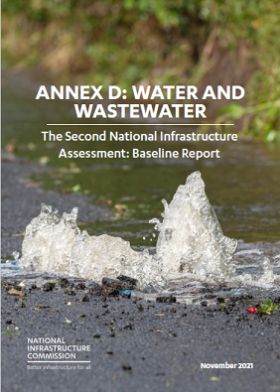
In a separate Annex paper which focuses on water and wastewater infrastructure for public water supply, the Commission also discusses the drainage services for properties provided by water and wastewater companies, including rainwater runoff from roofs, patios and paved areas.
The paper says that while the number of homes and businesses flooded has slowly declined over time, the number of properties flooded remains high with internal and external flooding increasing in the most recent year for which data is available.
Until 2018-19, internal and external sewer flooding was decreasing However, 2019-20 saw more than 3,500 properties flooded internally and almost 24,600 properties were flooded externally in England.
The NIC comments:
“More intense rainfall due to climate change could lead to increases in sewer flooding without action. Asset condition is variable with challenges around leakage levels, sewer collapses and an aging asset base. The level of leakage is still considerable within the sector, although there have been reductions in recent years. Resilience to drought remains a challenge for the sector.”
Serious pollution incidents caused by water companies have plateaued at "unacceptably high levels”
Pollution incidents are among a range of other issues addressed in the paper which states:
“The number of serious pollution incidents - those causing major or significant and extensive impact to the environment, people or properties caused by water companies decreased from 2002 but have plateaued since 2014 at unacceptably high levels.”
Commenting on river pollution, the NIC points out that this primarily comes from agriculture and water industry discharges and that pollutant loads from water industry discharges have declined by nearly 70 per cent since 1995.
However, the Commission says around 32 per cent of water bodies are failing to achieve good ecological status due to continuous discharges from sewage treatment works and seven per cent due to intermittent stormwater overflows, despite these improvements. The NIC is calling for “substantial improvement in both areas.”
According to the paper, climate change is likely to have a significant impact on water and wastewater services and extreme weather events, including high and low temperatures, could require changes to operations and asset management practices.
More intense rainfall also means that the risk of surface water flooding is likely to increase, thereby also increasing the pressure on water company sewerage assets. The NIC warns that this could result in more sewer flooding or more discharges from stormwater overflows which relieve pressure on sewerage systems by allowing discharges into water courses and that “such discharges have become an increasing cause of concern.”
The paper says:
“The water industry has a significant role to play and more to do to protect the environment from its operations. The water sector should take further action and aim to reduce serious pollution incidents to zero and make substantial improvements to discharges from sewage treatment works and stormwater overflows.”
Assessment in 2023 to set out recommendations on two challenges for both sectors
The NIC’s second Assessment (due in 2023) will carry out new analysis and develop recommendations on two challenges that will affect both the flood resilience sector and the water and wastewater sector.
Asset management and resilience – the Commission will consider how asset management can support resilience, barriers to investment, and the use of data and technology to improve the way assets are maintained.
Surface water management – the Commission will consider actions to maximise short term opportunities and improve long term planning, funding and governance arrangements for surface water management, while protecting water from pollution from drainage.
Click here to download The Second National Infrastructure Assessment: Baseline Report – Annex C: Flood Resilience
Click here to download The Second National Infrastructure Assessment: Baseline Report – Annex D: Water and Wastewater