


The Government has rejected the National Infrastructure Commission's call to set a national flood resilience standard.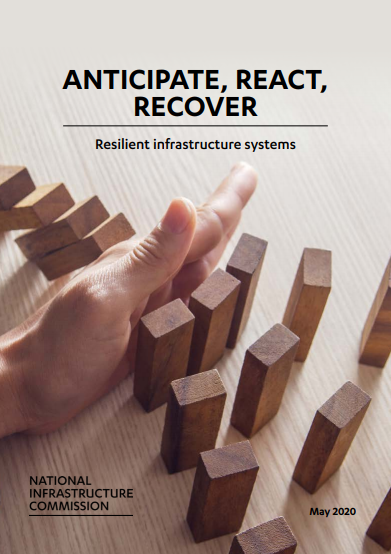
The Commission published its recommendations on addressing the impacts of flooding and improving flood resilience – including a new national standard for flood resilience – in the National Infrastructure Assessment in 2018, and more recently in its report published in May 2020 Anticipate, React, Recover: Resilient infrastructure systems.
The Commission has recommended that government should set out a strategy to deliver a nationwide standard of resilience to flooding with an annual likelihood of 0.5 per cent by 2050 where this is feasible. A higher standard of 0.1 per cent should be provided for densely populated areas where the costs per household are lower.
In a letter to Sir John Armitt, Chair of the National Infrastructure Commission, Rt Hon George Eustice MP Secretary of State for Environment, Food and Rural Affairs said:
“Whilst we welcome NIC’s work on resilience, we do not consider that standards of resilience to flooding are the right approach. The responses to our call for evidence on resilience in flood and coast contexts, and our research exploring different approaches to resilience, have demonstrated that there is no agreed understanding of resilience and no established method for assessing and quantifying flood resilience.”
According to the Minister, developing a method, and then any resilience standards based on it, would be a “complicated and resource intensive process” and “would not be effective for engaging the people and communities who are facing flood risks.”
Explaining that there are significant variations between local areas in the risks faced, potential for action and vulnerability of communities, George Eustice said that a standard which was achievable across the whole country would, inevitably, be a “lowest common denominator”.
“Whilst your report proposed that cities should have a higher standard than rural areas, we believe this approach may heighten differences between the different parts of the country rather than address them.
“Setting standards based on population density may also create artificial distinctions between places, overlooking the reliance of large cities on their surrounding catchments.”
In response, Sir John Armitt said that the Commission remained of the view that government should adopt a national flood resilience standard to give households and businesses confidence in the face of increasing flood risk, and to ensure no communities are left behind.
 With the UK government demanding a 50% reduction in storm overflow spills by 2029, the era of reactive management is over. Speaking in the House of Commons on 21 July 2025, then environment secretary Steve Reed said, “This Government will cut water companies’ sewage pollution in half by the end of the decade.”
 ERG, the leading supplier of odour control systems and industrial gas cleaning & thermal systems, has been awarded the coveted King’s Award for Enterprise.
 Welsh Water’s new artificial intelligence-driven tool, ORAI, has been shortlisted for three categories at the prestigious British Data Awards 2026 – underscoring the company’s commitment to using cutting-edge technology to deliver better outcome for customers.
 Barhale has completed work on two separate Rapid Action Taskforce Spills projects it is carrying out for Severn Trent.

 Hear how Scottish Water has completed its £235 million Ayrshire Glasgow Resilience Project - customers across Greater Glasgow, Ayrshire and East Renfrewshire will now benefit from a more secure and resilient water supply.
 Hear how United Utilities is accelerating its investment to reduce spills from storm overflows across the Northwest.
 Find out more about the remarkable career opportunities on offer at WSP - scroll down to watch the inspirational video.