
The Government's National Flood Resilience Review published today includes plans for improved rain and flood modelling, a £12.5 million increase in new temporary flood defences, greater protection to infrastructure and a call for water companies to strengthen flood resilience plans.
Environment Secretary Andrea Leadsom set out how lessons learnt from last winter’s floods have helped build a new approach so the nation is better prepared and more resilient to flooding, now and in coming years.
 The review was set up in January 2016 to assess how the country can be better protected from future flooding and extreme weather events such as during December 2015.
The review was chaired by the then Chancellor of the Duchy of Lancaster, with a team including Cabinet Office, Defra, the Environment Agency, the Met Office, and the government’s Chief Scientist.
The review includes:
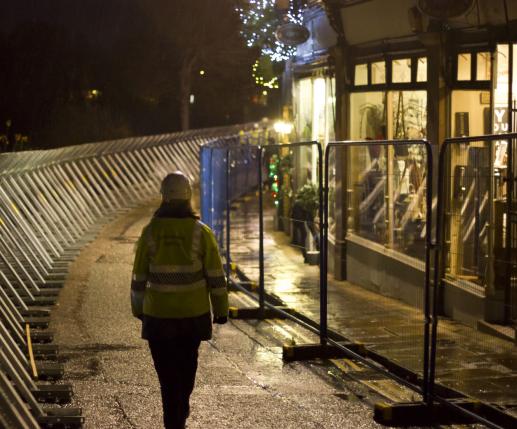
- £12.5 million for new temporary defences, such as barriers and high volume pumps, at seven strategic locations around the country. By this winter, the Environment Agency (EA) will have four times more temporary barriers than last year.
- Utility companies’ commitment to increase flood protection of their key local infrastructure, such as phone networks and water treatment works, so they are resilient to extreme flooding.
- A new stress test of the risk of flooding from rivers and the sea in England. For the first time, Met Office forecasts of extreme rainfall scenarios will be linked with Environment Agency modelling to provide a new assessment of flood risk.
Water companies to develop plans for temporary improvements to resilience
On the role that the water companies can play with regard to improved flood resilience, the report says:
“Working with the relevant utilities, regulators and government departments, we have agreed that, by Christmas 2016, the water and telecoms sectors will develop and implement plans for temporary improvements to resilience in line with those already available in the electricity supply industry.”
“These plans will ensure that the utilities obtain stock-piles of temporary defences in advance, and have ready site-specific plans for deploying them where appropriate and possible, if and when serious floods occur this coming winter.”
"In addition, we have agreed that (where not in place already) the water, telecoms and electricity utilities will develop over the remainder of this year, and will thereafter implement, longer term plans for permanently improving the resilience of service provision to significant local communities from the flooding defined by the Environment Agency’s Extreme Flood Outlines. “
“This could be delivered by increasing interconnectivity to enable service provision to be rerouted in the event of asset loss, or by the installation of permanent defences at significant local infrastructure asset sites, or (in cases where permanent defences are not cost-effective) through other measures where this is feasible.”
Ben Gummer, Minister for the Cabinet Office and Paymaster General, said the government has made clear that it expects water and telecoms companies to work “ever closer together” to improve their preparation and response to flooding, making sure lifelines such as mobile phone masts and water treatment works continue to function.
New flood modelling to make better use of data and technology
Environment Secretary Andrea Leadsom said:
“Last winter we saw just how devastating flooding can be. This review sets out clear actions so we are better prepared to respond quickly in the event of future flooding and can strengthen the nation’s flood defences.”
“Work is already underway towards £12.5 million of new temporary defences stationed around England, better protection for our infrastructure and new flood modelling that makes better use of data and technology.”
“We are absolutely committed to reducing the risk of flooding by investing £2.5 billion up to 2021 so we can help protect families, homes and businesses this winter.”
According to Sir Mark Walport, the Government Chief Scientific Adviser, the review used new modelling techniques to challenge ideas around the frequency and location of extreme flooding, commenting:
“It is important that policy on flood risk is underpinned by credible and objective scientific evidence and analysis.”
“We were able to model what level of rainfall would be worse than anything that we have experienced but still possible for our climate. This information enabled us to look again at how bad coastal and river flooding could be under such extreme conditions to ensure we are better prepared. This work was overseen by an expert group brought together from across industry and academia.”
On flood risk modelling, the review says that when a selection of the Environment Agency’s detailed models were used to predict the flooding associated with extreme rainfall scenarios, it discovered (unsurprisingly) that it was worse than anything seen to date.
However, the models suggested that even this plausible extreme flooding remains overwhelmingly within the areas and depths defined by the current Environment Agency Extreme Flood Outlines. With regard to scenarios involving extreme tidal surges, these too had produced flooding which is within the Extreme Flood Outlines, even when the tidal surges are combined with extreme rainfall scenarios.
“This gives us confidence that the Environment Agency Extreme Flood Outlines constitute a good representation of plausible severe fluvial and tidal flooding,” the review says.
Govt will now turn its attention to post-2021 flood defence investment
With the evidence of the National Flood Resilience Review, the government said it will now turn its attention to investment after 2021, making sure funds are directed where they are needed most.
This is intended to build on the £2.5 billion already being invested between 2015 and 2021 to strengthen flood and coastal defences, as well as spending £1 billion on maintaining the nation’s flood defences over this Parliament.
Following the National Flood Resilience Review, the government is launching four new projects to develop, test and accelerate new ways of managing the environment, including a project in Cumbria, which focuses on natural flood management strategies and up-to-date modelling and data tools.
Click here to read the National Flood Resilience Review report in full.
Waterbriefing is media partner with the Environment Agency’s major three-day conference and exhibition Flood and Coast 2017 which takes place from 28th to 30th March 2017 in Telford. Click here for more information