
A new report for the Civil Engineering Contractors Association has reinforced the need for infrastructure investment to strengthen the UK economy – the country is now falling seriously behind other global economies.
Securing our economy – The case for infrastructure says that the economic crisis faced by the UK has renewed focus on the country’s infrastructure and the potential role that improving utilities and national transport might play in reinvigorating growth. In CECA’s view, the report makes a compelling case and also provides a warning about the risks associated with any decline in activity.
According to Cebr, the report’s authors, UK GDP could have been five per cent higher, on average, each year between 2000 and 2010 if infrastructure had matched that of other leading global economies. Over 2000-2007, the UK was the lowest investor in infrastructure out of all OECD states. The World Economic Forum’s most recent 2012-13 Global Competitiveness Report ranked the UK 24th out of 144 countries for overall quality of infrastructure due to its comparatively modest levels of infrastructure spending.
The report estimates that the cost of the UK’s having infrastructure which fell short of typical developed economy standards was £78 billion each year between 2000-10, suggesting that if we fail to bring UK infrastructure up to the standard of other developed economies, by 2026 this could create a annual loss to the economy of £90 billion.
The report says that for each 1,000 jobs that are directly created in infrastructure construction, employment as a whole rises by 3,053 jobs. For each £1 billion increase in infrastructure investment, UK-wide GDP increases by a total of £1.299 billion, while every £1 billion of infrastructure construction increases overall economic activity by £2.842 billion.
The report also highlights a significant shift from public to private investment - the pattern of infrastructure construction output has changed dramatically since the early 1980s, both in terms of funding sources and infrastructure project type.
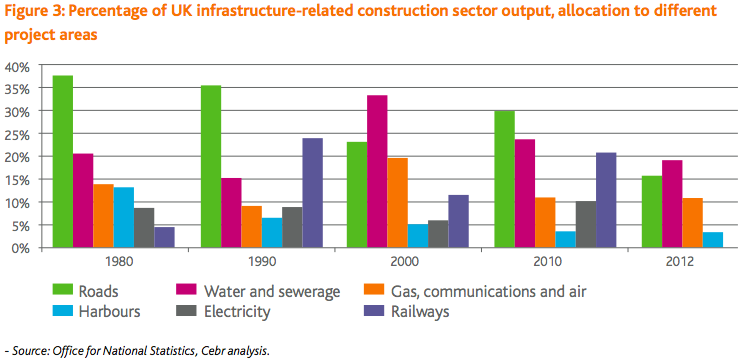
Public funding in 1980 contributed to the overwhelming majority of infrastructure-related construction output, with private funding contributing to just 3.5% of output. By 2010, 61.6% of this output was privately funded, as the share of publicly funded output fell to 38.4%. Notably, in 2012 the water and sewage sector delivered the greatest proportion of infrastructure construction investment, ahead of roads, gas and communications.
The Report is now calling for urgent action to be taken via a number of key recommendations, including:
- UK Government to establish a formal threshold for new infrastructure investment, ensuring that it does not fall below 0.8 per cent of GDP, the level at which significant detrimental impacts are created for the wider economy.
- UK Government to target new infrastructure investment to be at or above 1 per cent of GDP over the coming five years, to stimulate growth and close up the gap in the quality of UK infrastructure compared to international competitors.
- UK Government to develop a preparation pool of infrastructure projects that can be rapidly delivered, following a model successfully implemented by the Scottish Government.
- UK Government to expand the reduced ‘project rate’ of the Public Works Loan Board from one to three projects per Local Enterprise Partnership in England, and implement by November 2013. Require authorities drawing on the rate to demonstrate substantial private sector co-investment in funded projects.
- UK Government to create an independent body to analyse strategic challenges facing the UK, and to identify how infrastructure can play a part in resolving these concerns.
- Industry to work with Government in England, Scotland and Wales to identify and resolve non-financial barriers that are blocking construction of local infrastructure projects.